Can you use aluminium instead of stainless for a machined part?
Often yes, if the part stays below about 150°C, does not sit wet with salt, and the drawing is changed for a metal one third as stiff. 6082-T6 aluminium has a proof stress at least as high as 304 stainless in its softest condition, at a third of the weight. It also reaches far more shops: on one open quoting board, aluminium jobs drew six times as many quotes as stainless.
The swap fails when you copy the stainless drawing and change only the material note. Four lines on the drawing decide whether it works.
When does aluminium do the same job?
When the part is held to its shape by its load, not by its size. Strength is close. Stiffness, weight and heat are not.
| Property | Aluminium 6082-T6 | Stainless 1.4301 (304) |
|---|---|---|
| Proof stress | 240-255 MPa minimum (plate, EN 485-2) | From 220 MPa (softest condition) |
| Elastic modulus (stiffness) | 69-70 GPa | 200 GPa |
| Density | 2.7 g/cm³ | 7.8 g/cm³ |
| Thermal expansion | 23-24 µm/m·K | 16 µm/m·K |
| Upper service temperature (mechanical) | 170°C | 940°C |
So a bracket, housing, fixture plate or cover that carries a modest load indoors is a good candidate. Keep stainless when the part runs hot, when it must stay flat or rigid at a thin section, when it is wetted by salt water or salty air without protection, or when a code or your customer names the grade.
What must change on the drawing?
Four things. Miss one and the part can pass inspection and still fail.
- Section for stiffness. At the same shape, aluminium deflects about three times as much as stainless under the same load, because its modulus is about a third. Deflection falls with the cube of thickness, so a plate about 1.4 times as thick matches the stainless plate's stiffness, and still weighs about half as much. Ribs do the same with less metal.
- Threads that get used. A tapped thread in aluminium that is assembled often, or carries a high-strength bolt, should get a wire thread insert. Böllhoff, which makes HELICOIL, describes its inserts as non-wearing and says they increase the load capacity of the thread. Call the insert type and length out on the drawing; do not leave it to the shop. The guide to coil inserts on Vesprr Tools shows how they go in.
- Fasteners and contact with other metals. Stainless bolts in an aluminium part are normally safe, according to the British Stainless Steel Association. The risk is a conductive liquid bridging the two: in a marine setting it recorded severe pitting of aluminium under uninsulated stainless bolts, while bolts on the same ladder with insulating washers caused none. If the part lives near salt, specify the washers or a sealant.
- Finish with its thickness. Bare aluminium scratches and marks. Name the anodise type and coating thickness, and mark which features are sized after it. Hard anodise grows outward by about half its thickness per surface; the other half goes into the metal. Ordinary anodise on 6061 grows far less. A bore or a fit sized before the coating will come out undersize.
Expansion matters only on long parts bolted to steel: over 500 mm and 50°C, aluminium grows about 0.2 mm more than stainless.
Does the swap really make it cheaper?
Usually, and the bigger saving is in who will quote. Haizol put 60 live enquiries to 456 audited Chinese factories in early 2026. Aluminium enquiries drew 36.8 quotes on average, stainless 6.1, even though 397 of those factories list stainless machining. As the earlier post on why a stainless RFQ draws six quotes and aluminium 37 explains, the stainless price on a short run is mostly setup. More bidders give you a real price comparison, which a stainless job with six quotes rarely does.
Count the changes before you compare: thicker stock, inserts, anodising, washers. On a thin, heavily threaded part they can cancel the saving.
How do you test the swap before you commit?
Ask for two prices on the same RFQ. Send the stainless drawing as it is, and an aluminium version with the four changes above, at the same three quantities. You then see the real gap, not the material price alone. If the part carries load, have its designer check the new section first.
Send both drawings to Vesprr Workshop and ask for each part quoted in 304 stainless and in anodised 6082-T6. The reply will price both, so you can choose on numbers.
Sources
- Aluminium Alloy 6082-T6/T651 datasheet, Aalco: density, modulus, thermal expansion, EN 485-2 proof stress by plate thickness.
- 6082-T6 Aluminum, MakeItFrom: modulus, maximum mechanical temperature.
- EN 1.4301 (X5CrNi18-10) Stainless Steel, MakeItFrom: modulus, density, proof stress range, thermal expansion, maximum mechanical temperature.
- Bimetallic (galvanic) corrosion risks from contact with galvanised steel or aluminium, British Stainless Steel Association.
- HELICOIL repair solutions, Böllhoff: non-wearing thread inserts that increase the load capacity of the thread.
- Anodizing build-up vs. penetration, finishing.com forum: hard anodise about 50% build-up per surface; ordinary anodise on 6061 far less.
- China CNC Machining Industry Report 2026, Haizol: quotes per enquiry by material, stainless capability across 456 factories.
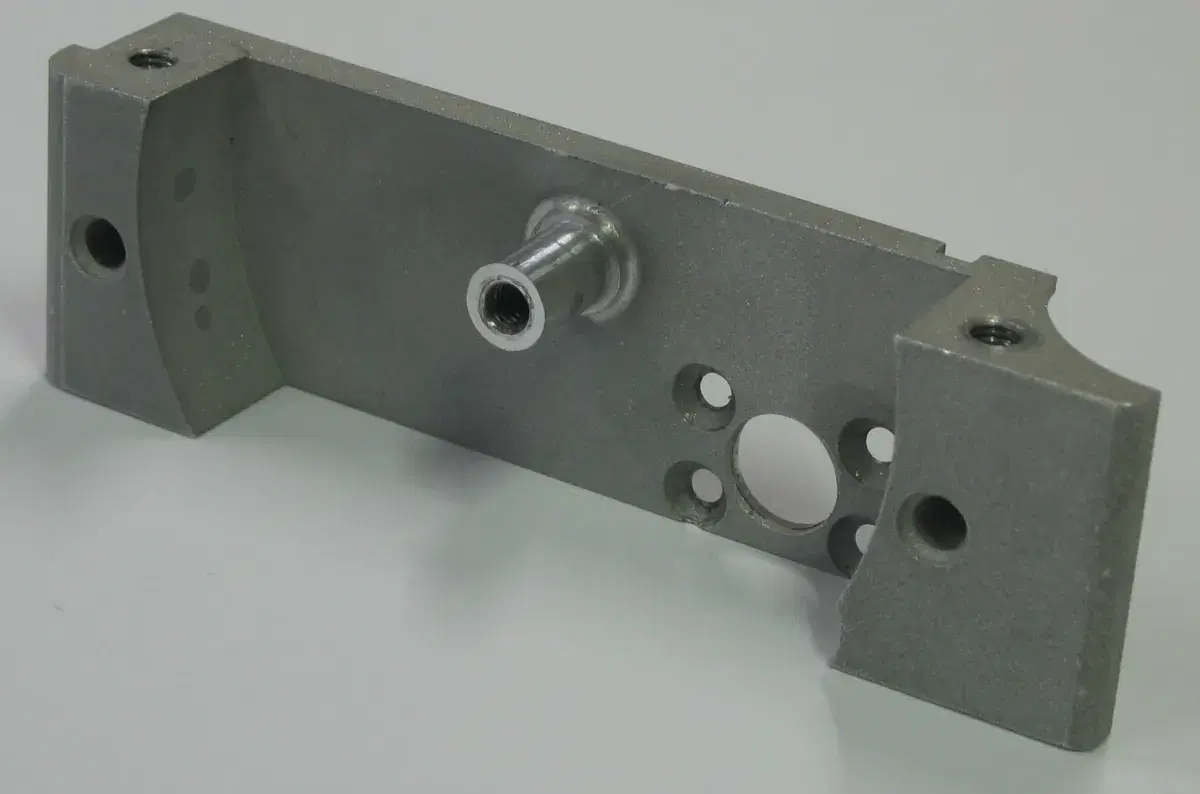
- CAD model and CNC machined part, Mike1024, public domain, via Wikimedia Commons (header photo).
