Why a stainless RFQ draws six quotes and aluminium 37
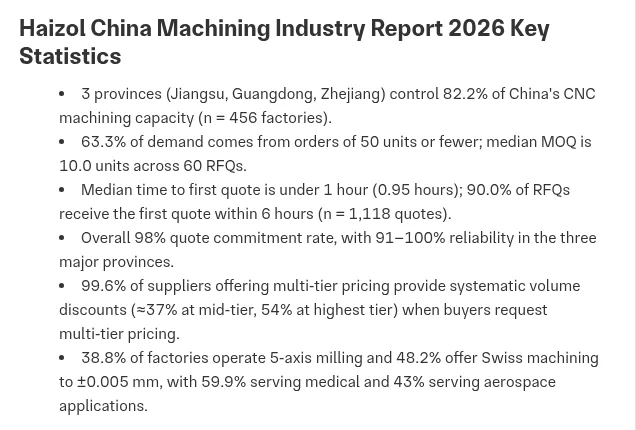
Because on an open board a stainless job is the one shops skip. Haizol put 60 live enquiries through its marketplace in early 2026 and collected 1,118 quotes from 456 audited Chinese factories: an aluminium enquiry drew 36.8 quotes on average, carbon steel 17.4, stainless 6.1. Capability is not the constraint — 397 of those 456 factories list stainless machining.
What they are pricing is setup. Across 260 multi-tier quotes, stainless fell 43.9 per cent from prototype price to volume price, against 15.8 per cent for carbon steel and 34.3 per cent for aluminium. A discount that steep means a large fixed cost being spread thin, and a shop looking at your one-off is looking straight at the un-spread version of it.
| Material | Quotes per enquiry | Enquiries in sample |
|---|---|---|
| Aluminium | 36.8 | 11 |
| Carbon steel | 17.4 | 11 |
| Stainless steel | 6.1 | 10 |
Put three quantities in the enquiry
This is the change that costs you one line and pays immediately. Only a quarter of the buyers in the sample asked for tiered pricing. Those who did were quoted 37.4 per cent off at roughly ten times the volume and 53.8 per cent off at a hundred times, and 99.6 per cent of suppliers who offer tiers applied them systematically. The steps were already in the pricing models; nobody was made to show them.
Ask for 10, 100 and 1,000 even when you only intend to buy ten. You will see where the setup sits in the price, which tells you whether the quote in front of you is expensive or simply short-run — and it moves the setup-cost conversation into your numbers rather than the supplier's.
Send it to seven or ten named shops, not a board
Haizol's own recommendation, from the spread in its data, is seven to ten quotes per enquiry. That is the number that captures most of the price variance without becoming a job in itself, and on a thinly quoted material you will not get there by posting and waiting.
While you are narrowing the list, ask for the certificate rather than the customer list: 69.3 per cent of the audited factories say they serve automotive customers and 27.9 per cent hold IATF 16949. The gap between those two numbers is the one to ask about.
Short runs are not what is putting shops off, whatever the folklore says. Of the 60 enquiries, 43.3 per cent were for one to five pieces and 63.3 per cent were for 50 or fewer; the median minimum order was ten units, and the one-to-five-piece enquiries drew 18.7 quotes each. Volume is not the filter. Material is.
Do not budget on "42 per cent cheaper"
That figure has travelled a long way from what it is. Haizol states it does not hold matching Western quotes for identical parts, so the comparison is scenario modelling against a $1,000 baseline. The typical case lands at a 42 per cent saving and the best case at 83 per cent — but the worst case, once air freight, 25 per cent tariffs and a quality buffer are added, is a 26 per cent premium.
Budget the worst case for a first article and the typical case for a repeat order. The internal spread between Chinese suppliers is wider than freight and duty combined, which is the real argument for going out to seven quotes rather than two.
If you want a stainless part priced at three quantities, send the drawing to Vesprr Workshop and you will get the tiers back with the price. If it is not ours to make, we will say so in the same reply.
Sources
- Haizol, China CNC Machining Industry Report 2026 — the 456 audited factories, 60 enquiries and 1,118 quotes, quotes per enquiry by material, the volume-discount averages, the multi-tier findings, the IATF 16949 and automotive shares, the order-size split, and the $1,000 Western-baseline scenario with its stated limits. Live-enquiry window 30 January to 6 February 2026.
- CNC Machining in China: We Analyzed 1,118 Factory Quotes (What You're Getting Wrong) by HAIZOL — the company's own walk through the findings.
- How to Source Low-Volume CNC Machining (MOQ, Lead Time and Cost Guide) by HAIZOL — why setup cost dominates short runs.