Six lines to send with an RFQ so the quote comes back
Send six things and a shop can price your part without calling you. A STEP model and a PDF drawing. Material, grade, condition and thickness. The quantity you will actually order, and whether it repeats. A general tolerance block with three or four features tightened on purpose. Finish, hardware and inspection. And the date you need parts in hand.
Leave any one of those out and the first reply is a question, not a price — and the week you lose is yours, not the shop's.
- A STEP model and a PDF drawing. The model gets programmed, the drawing gets inspected. One without the other means somebody rebuilds your part from assumptions, at your expense.
- Material, grade, condition, thickness. 5052-H32 at 3 mm, not "aluminium". On a formed part the thickness sets the bend radius, the hole clearances and the minimum flange, so leaving it off quietly voids the rest of the drawing.
- The quantity you will actually order. One and a hundred are different jobs, priced differently and often tooled differently.
- A general tolerance block, then three or four tightened features — the ones that locate, seal or mate — each with a way to measure it that you or the shop already own.
- Finish, hardware, inspection. Powder coat colour, plating spec, inserts, first-article report or not. Each is an operation with its own lead time, and each one found later is a revised quote.
- A date. Not "ASAP". Bending alone adds a day or two before finishing even starts.
Which tolerances to tighten, and which ones cost you
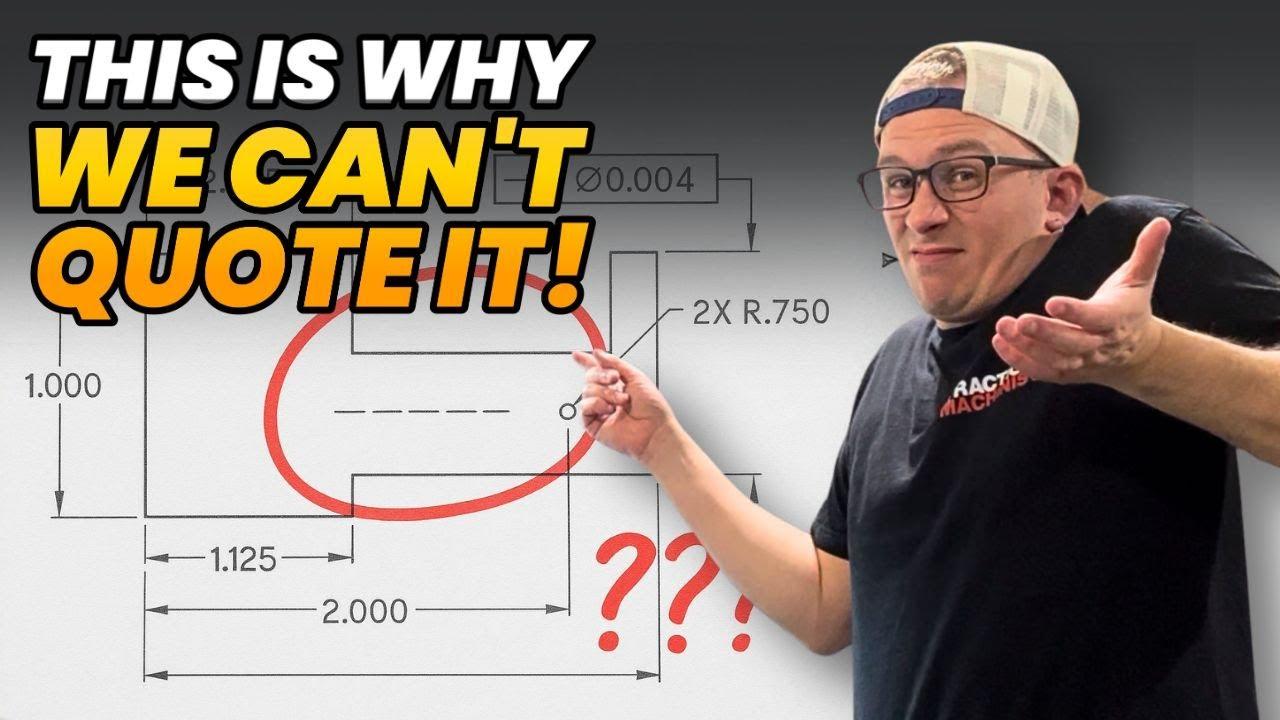
Tighten only what has to be held, and only where somebody can measure it. Ian Sandusky of Lakewood Machine and Tool walked through the drawing that taught this lesson on Practical Machinist: a part sent to shop after shop with no replies, carrying tolerances in millionths on almost every feature, angular tolerances on countersinks nobody could think how to check, redundant dimensions on the same edges, and no material thickness anywhere. The buyer wanted twenty to thirty parts for $300 all in. The shops reading it put the number nearer $1,000 each.
"I don't even have equipment in my shop to measure something to that tight of a tolerance." — Ian Sandusky, Watch Out For These RED FLAGS In an RFQ, Practical Machinist
None of that is about price. A shop reads a drawing for what it is made of, how many, and which features genuinely have to be held. If it has to guess at any of those, the cheapest move is to close the email, because quoting low on a guess costs more than not quoting at all.
On formed parts there is a hard floor, and the instant-quote platforms publish it where a shop would only mutter it. SendCutSend holds bend-to-edge to ±0.015 in, with every additional bend adding at least another 0.015 in, and bend angle to ±1° up to 24 in and ±2° beyond. Laser-cut holes have to be at least 50% of material thickness. Bend radius and K factor are fixed per material and thickness; custom radii are not offered. So a ±0.005 in call-out on a bent flange is not a tolerance — it is a request to machine a formed part, at several times the price, and most of the time nobody wanted that.
Why quantity moves the price more than the drawing does
Most of a quantity-one price is setup, spread across one piece. SendCutSend publishes two worked examples that show the size of it.
| Part | At one | At a hundred |
|---|---|---|
| G90 galvanised steel, 0.059 in — laser cut, bent, hardware inserted | $31.76 each | $8.32 each |
| Cold rolled steel, 0.119 in — cut, bent, dimpled, tapped, powder coated | $73.33 each | $16.21 each |
The company notes these are general estimates rather than live prices, and the ratio is the point rather than the figures. An RFQ that hides the real quantity, or asks for "a price for one to start", gets the expensive number by default — and a prototype you say will become a 500-a-year part gets tooled for that, which usually makes both numbers smaller.
Put the six lines in the email with the file. Vesprr Workshop will come back with the price and tell you which feature is driving it.
Sources
- Watch Out For These RED FLAGS In an RFQ | Machine Shop Talk Ep. 75 — Ian Sandusky, Practical Machinist. The forum drawing, the millionths tolerances, the missing thickness, and the $300 budget against roughly $1,000 a part.
- Stop Sending RFQs Like This — Here's Why Shops Won't Quote It — Practical Machinist. The shop-side list of what an RFQ needs: quantity, material, lead time, tolerances, drawing and CAD.
- Bending guidelines — SendCutSend. Bend-to-edge and bend-angle tolerances, the 50%-of-thickness minimum hole, fixed bend radius and K factor, the one-to-two-day addition for bending, and the two worked price examples with their estimate caveat.