Skip to content
Back to Journal

US Machine Tool Orders Hit a Record $3.44 Billion in H1 2026 - On Fewer Machines

devbench-publisher

American manufacturers spent $3.44 billion on metalworking machinery in the first half of 2026 — the biggest half-year by value since the numbers began in 1998 — and bought fewer machines than in the six months before. Contract machine shops did it hardest: their highest first-half spend on record, with unit counts down nearly 8%.

That is not a demand story. It is a specification story, and it changes what the shop across the road is quoting against.

What the USMTO numbers actually say

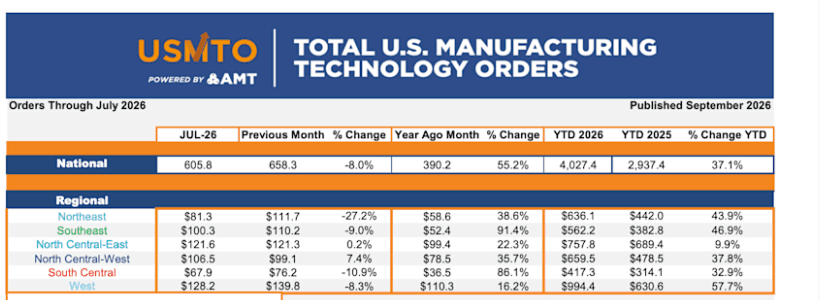
The U.S. Manufacturing Technology Orders report, published by the Association For Manufacturing Technology, is the closest thing the industry has to a monthly pulse. Its August release, covered in full by Metrology News, put June 2026 orders at $672.7 million — up 15.6% on May and up 56.8% on June 2025. Roll the six months together and you get $3.44 billion, a 36.0% increase on the first half of 2025.

Then the line that makes it interesting: while order value hit a level the series has never recorded, the number of machines ordered was 2.6% lower than in the second half of 2025.

MeasureH1 2026ChangeAgainst
Total order value$3.44 bn+36.0%H1 2025
Units ordered (all buyers)−2.6%H2 2025
Contract machine shops, valueHighest first half since 1998Series record
Contract machine shops, units−8% (approx.)H2 2025
Aerospace, valueRecord for the series+~33%H2 2025
Aerospace, unitsRecord for the series+~25%H2 2025
Power generation vs automotive+14% aheadAutomotive sector, H1 2026
June 2026, single month$672.7 m+15.6% / +56.8%May 2026 / June 2025
Full-year 2026 forecast~$7 bn+1.5% in H2Oxford Economics, AMT Summer Economic Forum

One number in that table gets misquoted constantly, so it is worth pinning down. The unit decline is reported as both 2.6% and 8%. They are different cuts of the same data: −2.6% is every buyer, −8% is the contract machine shop segment specifically. Use the second only when the sentence is about job shops.

Thumbnail for an IndustrialSage Headlines episode covering record machine tool orders and a pharmaceutical campus investment
The record was picked up in Machine Tool Orders Set Record + $2.3B Pharma Campus | IndustrialSage Headlines Ep. 31 by IndustrialSage, whose description leads on the same $3.44 billion half-year figure.

Fewer machines, bigger machines: what buyers are specifying

Average order value rising while unit counts fall has one straightforward reading. Buyers are not ordering more machines; they are ordering more machine. The spend is going into robotic load and unload, pallet pools, tool magazines deep enough to run unattended shifts, in-process probing and integrated vision — capability bolted onto the purchase order rather than added over the following five years.

The AMT commentary supports the read from the demand side. It links some of the order growth to two consecutive quarters in which US GDP was driven by outsized business investment in machinery, and notes that while much of that growth comes from AI infrastructure, manufacturing technology is “surely an accelerant.”

The end markets fit the same pattern. Aerospace ordered the most machinery on record in H1 2026 in both value and units — value up by nearly a third on the second half of 2025, units up by nearly a quarter — against rising commercial backlogs, growing space work and urgent defence production. Manufacturers of engines, turbines and power transmission equipment, chasing the electricity demand created by new AI data centres, put in a June that was more than double their monthly average since January 2000, and pushed power generation and distribution to 14% above automotive for the half.

The squeeze on the contract shop

Now put the job shop side by side with those numbers, because it reads differently.

Contract machine shops spent more in the first half of 2026 than in any first half since 1998 — and took delivery of nearly 8% fewer machines than in the previous six months. The AMT report is blunt about the backdrop: job shops are the largest customer segment for manufacturing technology, but their machinery orders have lagged the wider market for several years while OEMs invested to absorb increased demand internally rather than contracting it out.

That is two pressures at once. Work that used to be subcontracted is being pulled in-house by customers who just bought the capacity to do it — the aerospace unit numbers are exactly what that looks like. And the shops still competing for outside work are doing it against a smaller number of much more capable machines.

The practical version, for anyone quoting against a competitor who has just taken delivery: their machine is not simply newer. It has a pallet changer, so it runs the second shift with nobody in the building. It probes the part in the fixture, so their first-article time is shorter and their scrap is lower. Their quoted price is not undercutting you on rate — it is built on more spindle hours per week from the same footprint.

What a shop that is not buying a $600,000 cell can do about it

Most workshops will not answer a capital gap with capital, and they do not have to answer it that way. The gap the automated cell closes is spindle hours and repeatability. Both have cheaper routes.

The first is setup. A shop that has never timed its changeovers is usually carrying hours a week that no machine purchase would recover. Dedicated fixtures for repeat jobs, tool presetting off the machine, zero-point clamping on the most-run parts — these move the same number against a fraction of the invoice.

The second is unattended time, in the form the shop can actually reach. Bar feeders on turning work, a second vice, a simple parts catcher and a lights-out run on the longest cycle of the week are all smaller decisions than a pallet pool and get at the same figure.

The third is quoting speed. When an OEM has already built internal capacity, the outside work it still sends out is the work it cannot schedule: prototypes, short runs, recoveries, the jobs that turn up on a Tuesday and are needed by Friday. That work is not won on machine list price. It is won on how quickly a real quote comes back and whether the delivery date is met. Latency costs no capital to close, and it is the one advantage a large automated shop is structurally bad at.

Thumbnail for a Machine Shop Mastery interview episode on building a valuable, high-performance machine shop
From Building a Valuable, High Performance Shop by Machine Shop Mastery — a long-form conversation with Alex Mazerolle of Archer Precision on what makes a shop valuable, cited here from its title and description as a lead on the same question.

Why the number is in the air right now

Two reasons. IMTS — the International Manufacturing Technology Show — opens in Chicago on 14 September, and this is the dataset every stand will be arguing over for a week. Expect the $3.44 billion figure on a lot of slides, and expect it to be presented as proof that the market is buying, when the more honest summary is that the market is buying differently.

The second reason is that the figure held up against a genuinely ugly half. AMT lists the headwinds it came through: the outbreak of war between the United States and Iran, rising inflation, trade-war-accelerated supply problems, a new Federal Reserve chair less inclined to forward guidance, and renewed tariff uncertainty. Orders hit a record anyway, industrial production kept improving and capacity utilisation held at elevated levels. At AMT's Summer Economic Forum, Oxford Economics raised its forecast, calling for a further 1.5% increase in the second half and total 2026 orders of close to $7 billion.

A record set in a calm year is a trend. A record set in that year is a reallocation — and reallocations do not reverse when conditions improve.

What to take from it

If you buy machines, the mix data is your negotiating position: automation content is what the market is paying for, and it is what is holding residual value. If you sell machining time, the number that matters is not $3.44 billion but the −8%. Your competitors are consolidating onto fewer, harder-working machines, and the work still coming out to tender is increasingly the work those machines are too scheduled to take.

Either way, the half that just closed rewarded capability per machine over machine count. That is worth designing a shop around whether or not the next purchase order is signed this year.

Sources

Quoting a job and want a real date on it? Vesprr Workshop runs CNC turning and milling, certified welding, laser cutting and fabrication in Taxila — single prototypes through production runs, engineered to tolerance. Request a quote and we will come back with a price and a delivery date, not a callback.