
FANUC's AI Welding Agent reads the drawing and writes the weld — shipping December, and here is what the release does not say
Eleven September, 2026. FANUC put out three welding releases before Tokyo opened for business, and the one that matters says a CRX cobot will read an engineering drawing off the camera in its own tablet teach pendant and write the weld — current, voltage, the robot path — with what the company calls "zero setup and zero teaching". Shipments start at the end of December. There is no price in the release, no cycle time, no named customer, and no list of joint types. Those absences are the story as much as the product is.
The release is on fanuc.co.jp and runs to about 600 words. Nikkei Asia carried it the same morning behind a paywall. The primary source is shorter, and it is the one to read, because the trade coverage will fill the gaps with adjectives and the release does not.
What the release actually commits FANUC to
Four things, each with a date or a mechanism attached.
First, the product. The AI Welding Agent is "a Physical AI system for industrial robots, utilizing Gemini Enterprise, Google's enterprise-grade generative AI platform". It "reads an engineering drawing for an arc-welding part, understands the materials and a final shape of the part, and automatically generates" two outputs: welding parameters "such as current and voltage", and "robot motion programs". The operator can run those as generated "or fine-tune them before welding".
Second, the hardware. None extra. The drawing is captured by "the built-in camera of the CRX tablet teach pendant (TP)"; "no additional cameras or dedicated devices are required at the production site". It is "independent of any specific welding power sources" and "can be used with any welding power supply connected to a FANUC robot".
Third, the contract. Customers "do not necessarily need to establish separate enterprise agreements with Google Cloud"; the service "can be subscribed to quickly and easily through existing FANUC contractual arrangements". Drawings "are not used for training other users' AI models".
Fourth, the dates. A live demonstration at the Japan International Welding Show, Tokyo Big Sight, from 16 September; shipments "scheduled to begin at the end of December 2026".

What it does not say
Read the release again for the numbers that are missing and the list is longer than the list of numbers that are there.
| Item | What the 11 September release says | Source |
|---|---|---|
| Ship date | "End of December 2026" | FANUC release |
| First public demo | 16 September, Tokyo Big Sight (show runs 16–19 Sept, West Halls 1–2) | FANUC release; Tokyo Big Sight event listing |
| Extra hardware | None — CRX tablet TP camera only | FANUC release |
| Power source | Any welding power supply connected to a FANUC robot | FANUC release |
| Google contract | Not necessarily required; via existing FANUC arrangements | FANUC release |
| Physical AI robots shipped since iREX (Dec 2025) | "More than 1,000" | FANUC, 13 May 2026 release |
| Price or subscription fee | Not disclosed | — |
| Cycle time, throughput, or programming-time saving | Not disclosed | — |
| Supported joint types, materials, thicknesses | Not disclosed | — |
| Accuracy or first-pass acceptance rate | Not disclosed | — |
| Named customer or pilot site | Not disclosed | — |
| Which CRX models | Not stated beyond the tablet TP requirement | — |
Five "not disclosed" rows against a product that ships in fifteen weeks. That is not unusual for a Japanese robot maker announcing at a trade show, and the May release carried no price either. But it means the only verifiable claims today are the mechanism and the calendar. Everything a fabrication shop would want before quoting robotic capacity for 2027 — what it costs, how fast it is, what it will refuse — is not yet on paper.
One more thing the release does not say: which model. "Gemini Enterprise" is Google's platform name, and FANUC does not name the model underneath it. Trade writers will upgrade that to a model name by lunchtime. The release does not.
Where this came from: four months, two releases
This did not appear from nowhere. FANUC's 13 May 2026 release announced the Google collaboration and said the company had "already shipped more than 1,000 robots for Physical AI related applications" since showing the system at iREX last December. It named Gemini Enterprise, said all FANUC robots including CRX would be supported on Intrinsic's Flowstate environment, and that FANUC had joined Google DeepMind's Gemini Robotics Trusted Tester Program. The May demo was natural-language instruction to a robot cell — tell it what to do, it does it.
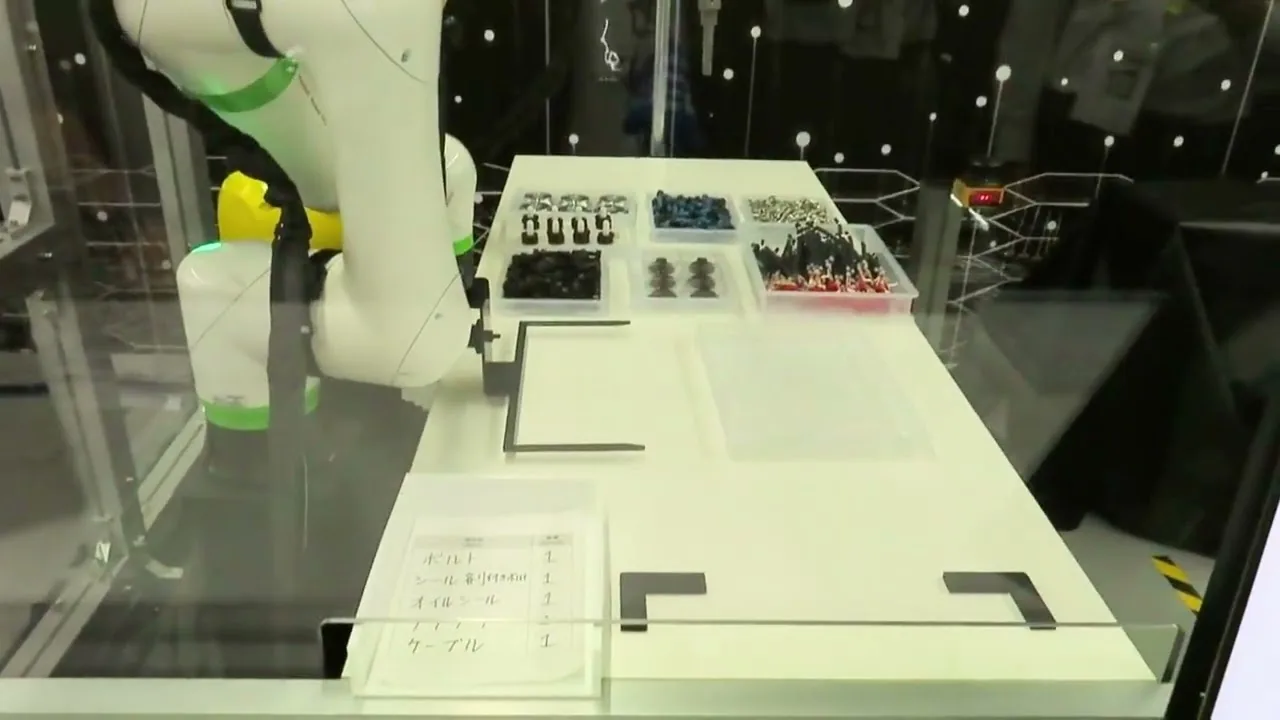
The 11 September release narrows that to one task with a drawing as the input. That is the sensible order: a general "AI agent operates robots" demo is a trade-show act, and a "read this drawing and weld it" product is something a shop can test against a part it already makes. SEISANZAI Japan's short report on the May announcement is the clearest record of what the May system looked like; the September system is that idea pointed at arc welding.
It is also the second half of a story this site's software division ran yesterday. CloudNC's CAM Assist drafts a CNC program from the CAD model; FANUC's agent drafts a weld program from the drawing. Same shape, different side of the aisle. CloudNC's limit is 3-axis and 3+2 work. FANUC has not published its equivalent limit yet, and the honest position is that nobody outside FANUC and Google knows what it is until the show floor opens on Wednesday.
The two releases nobody will cover
The same morning, FANUC published two more welding systems for the same show, and both have numbers in them where the AI release does not.
The CRX laser welding system pairs a handheld laser welder with a CRX cobot for high-mix, low-volume work. The mechanism is specific: for pipe, the fixture rotates the pipe at constant speed under a fixed torch, laser power is adjusted automatically as the robot's speed changes, and the same laser source removes weld discoloration afterwards. If the cobot's contact-stop fires, the laser cuts. That last line is the one a safety officer will read first, and it is a better piece of engineering disclosure than anything in the AI release.
The CRX Structural Column Welding System is the 11 kg CRX-3iA on a magnetic base. Tool-free install, the robot detects its own mounting angle, laser or touch sensing finds the joint, and four robots on four corners weld an 800 mm square column. FANUC says it grew out of shipyard use, where "a single operator [manages] multiple robots simultaneously" — set one welding, carry the next into position. This is the release with a workforce claim that can actually be tested: one welder, four arms, one column.
| CRX model | Max payload at wrist | Reach (J4 = +90°) | Mass |
|---|---|---|---|
| CRX-3iA | 3 kg | 692 mm | 11 kg |
| CRX-5iA | 5 kg | 994 mm | 25 kg |
| CRX-10iA | 10 kg | 1,249 mm | 40 kg |
| CRX-10iA/L | 10 kg | 1,418 mm | 41 kg |
| CRX-20iA/L | 20 kg | 1,418 mm | 41 kg |
| CRX-30iA | 30 kg | 1,756 mm (30 kg mode) | 135 kg |
Source: FANUC collaborative robot lineup page, read 11 September 2026. The AI Welding Agent release names no specific CRX model.
What "zero teaching" leaves for the welder
Here is the reading a fabrication shop should take from the wording. The release says the operator "can either execute the welding parameters and robot motions generated by the AI Welding Agent as-is, or fine-tune them". That sentence puts the sign-off on the human. The agent proposes; someone with a welding ticket approves. FANUC's own justification for the product is "the shortage of skilled welders capable of optimizing welding parameters and teaching robot motions" — which is an admission that the person checking the AI's output needs to be exactly the person the industry is short of.
So the labour saving is not "no welder". It is "one welder signs off what would previously have taken that welder an afternoon on the pendant". Whether that is a 30% saving or a 90% saving is the number FANUC has not published, and until it does, any figure in the trade press is somebody's guess.
Then the failure case. Drawings are wrong more often than robots are. A weld symbol on the wrong side, a missing throat size, a revision that never reached the shop floor. The release says the agent "understands the materials and a final shape of the part". It does not say what it does when the drawing does not add up. That is the question to ask at the FANUC stand on Wednesday, and the answer decides whether this is a tool for a job shop in Taxila or only for a truck-frame line with drawings that have been right for ten years.
What I would tell a customer asking whether to wait for it: the December date is real and the mechanism is credible — the tablet camera exists, Gemini Enterprise exists, CRX arc welding exists and has for five years. What does not yet exist is a price, a throughput figure or a list of what it will not weld. Quote your 2027 robotic capacity on what the CRX does today — FANUC America's own short on welding and cutting with the CRX is a fair picture of that. If FANUC publishes the numbers after the show, revise upward then.
Vesprr's workshop does MIG, TIG and arc welding for structural steel and custom assemblies in Taxila. If you have a drawing and want it welded by a person this quarter rather than an agent next year, send it for a quote.
Sources
- FANUC CORPORATION, news release, 11 September 2026: FANUC Accelerates Physical AI in Arc Welding with the New "AI Welding Agent"
- FANUC CORPORATION, 11 September 2026: High-Speed, Low-Distortion Pipe Welding (CRX laser welding system)
- FANUC CORPORATION, 11 September 2026: Ultra-Lightweight, Easy-to-Install Portable Collaborative Robot Accelerates Automation on Construction Sites
- FANUC CORPORATION, 13 May 2026: FANUC Accelerates the Physical AI Through Collaboration with Google
- FANUC CORPORATION, product page: FANUC Robot CRX series (payload, reach, mass)
- Tokyo Big Sight, event listing: Japan International Welding Show 2026, 16–19 September, West Halls 1–2; organiser's site: weldingshow.jp
- Video: FANUC announces partnership with Google to accelerate deployment of physical AI robot systems — SEISANZAI Japan Official YouTube Channel
- Video: Collaborative Arc Welding Robot with Guided Teaching – FANUC CRX10iA — FANUC America Corporation
- Video: Welding and Cutting Using the FANUC CRX Cobot — FANUC America Corporation
- Vesprr Software, 10 September 2026: An AI that writes CNC programs just raised $20m