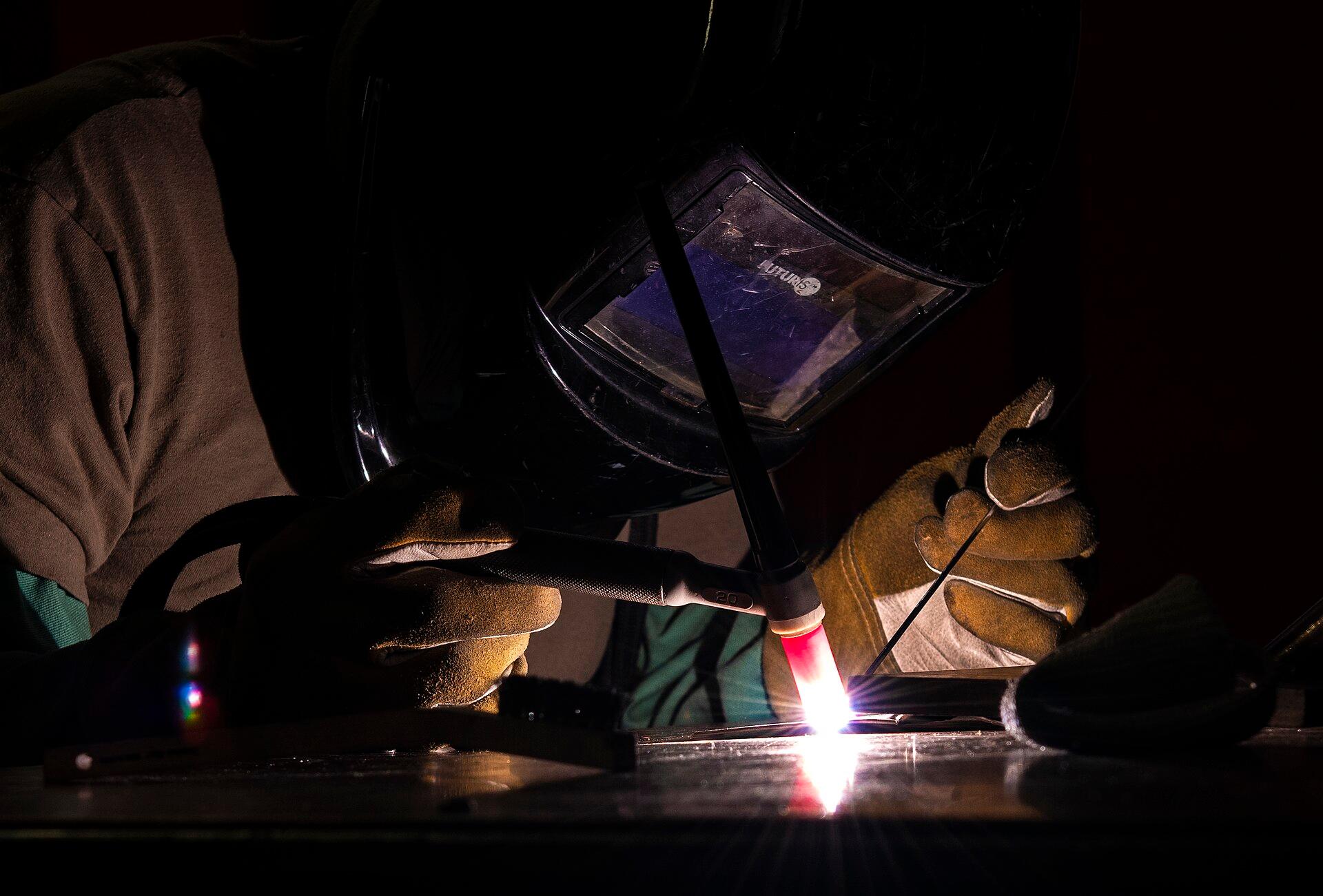
Does welding 6061-T6 or 6082-T6 make it weaker?
Yes. Welding softens a band of metal either side of the weld, called the heat-affected zone, and there a T6 part keeps only about 60% of its tensile strength and half its proof strength. Ageing the part afterwards does not bring that back. So a welded 6061-T6 or 6082-T6 part is sized to the as-welded figures, has its welds moved to where the load is low, or goes through a full re-heat-treatment.
This follows the guide on choosing between 6061 and 6082, which says the temper matters more than the grade. Welding is where that temper is lost.
How much strength does the weld zone lose?
About 40% of the tensile strength and just over half the proof strength, in both grades. The codes give these minimums:
| Material and code | Tensile, unwelded | Tensile, weld zone | Proof, unwelded | Proof, weld zone |
|---|---|---|---|---|
| 6061-T6 sheet and plate up to 12.5 mm (EN 1999-1-1) | 290 MPa | 175 MPa | 240 MPa | 115 MPa |
| 6082-T6 sheet and plate up to 6 mm (EN 1999-1-1) | 310 MPa | 185 MPa | 260 MPa | 125 MPa |
| 6082-T6 extrusions up to 5 mm (EN 1999-1-1) | 290 MPa | 185 MPa | 250 MPa | 125 MPa |
| 6061-T6, most product forms (US practice; weld zone figure from AWS D1.2 and ASME) | 40 ksi (276 MPa) | 24 ksi (165 MPa) | - | - |
The Eurocode figures assume MIG welding up to 15 mm thick. For TIG welding 6xxx alloys up to 6 mm, Eurocode 9 multiplies them by 0.8, because TIG puts more heat into the part. Thicker sections take a further 0.8. The figures apply only three days after welding, with the part kept at 10°C or warmer, so do not proof-load a part the day it is welded.
Do not count on hidden margin. Frank Armao, long-time aluminium columnist for The Fabricator, notes that 6061-T6 procedure tests usually reach only 25 or 26 ksi.
How far from the weld does it reach?
Further than you can see. For a MIG weld, EN 1999-1-1 takes the softened zone to run 20 mm from the weld on material up to 6 mm thick, 30 mm up to 12 mm, 35 mm up to 25 mm and 40 mm beyond that. For TIG on material up to 6 mm it is 30 mm. Welds closer than this share one soft zone, and a weld within three times this distance of a free edge softens the whole width to that edge.
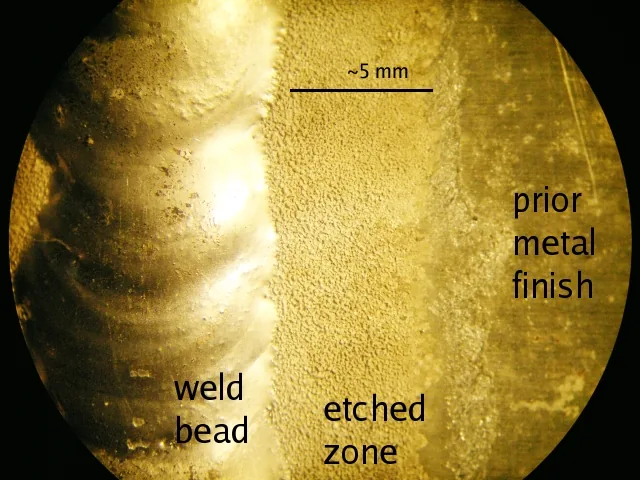
This decides where a weld can go. A bracket welded at the root of a cantilever puts its weakest metal where the bending stress peaks. Move the weld along, or add material at the root.
Can heat treatment after welding restore it?
Only a full one, and it costs more than most parts justify:
- Ageing alone does not work. Armao reports aged welds only 1 to 2 ksi stronger, at 25 to 27 ksi.
"...which isn't anywhere close to T6 properties." Frank Armao, The Fabricator
- A full solution treatment and age restores T6. The part is heated to around 1,000°F (about 540°C), quenched in cold water, then aged at about 400°F (about 200°C). The quench usually distorts the part, which must be straightened before ageing. Budget for a heat-treatment subcontract, extra lead time, and machining critical faces afterwards.
- Weld in T4, then age. Armao reports about 35 ksi (241 MPa) this way, against 24 ksi as welded. But T4 stock is hard to buy in small quantities, and the fabrication codes give no credit for it, so a coded design still uses 24 ksi.
For most fabricated parts the cheapest answer is a slightly heavier section sized to the as-welded strength. Re-heat-treatment earns its place only when weight or section size is fixed.
What should the drawing say?
Which strength the welded section was sized to, where welds may not go, and the filler if your calculation depends on it. EN 1999-1-1 gives two fillers for 6082-T6, and welds made with 5356 (AlMg5) are stronger than those made with 4043 (AlSi5). If you need T6 after welding, say so and allow for distortion:
MATERIAL: EN AW-6082-T6. WELDED JOINTS SIZED TO AS-WELDED (HAZ) STRENGTH. FILLER: ER5356. NO WELDS WITHIN 40 MM OF SECTION A-A.
Send your drawing to Vesprr Workshop's welding service with the loaded section marked, and ask for the quote to state the welding process and filler that will be used.
Sources
- Aluminum workshop: 6061-T6 tensile strength restoration, Frank Armao, The Fabricator.
- EN 1999-1-1 (Eurocode 9), as adopted in the bilingual DSTU-N B EN 1999-1-1:2010: Table 3.2 HAZ strengths and the TIG and thickness factors and 6.1.6.2 recovery time and 6.1.6.3 extent of the HAZ.
- Experimental investigation of aluminum welded lattice girders, Šemso Kalač, Naja Zejnelagić, Đorđe Đuričić and Duško Lučić, Journal of Applied Engineering Science, 2024.
- Header photo: TIG welding at RAF Lakenheath, Airman 1st Class Jessi Roth, U.S. Air Force, public domain, via Wikimedia Commons.
- Inline photo: TIG weld on 4 mm 6061 plate, Dr. Crash, public domain, via Wikimedia Commons.

